
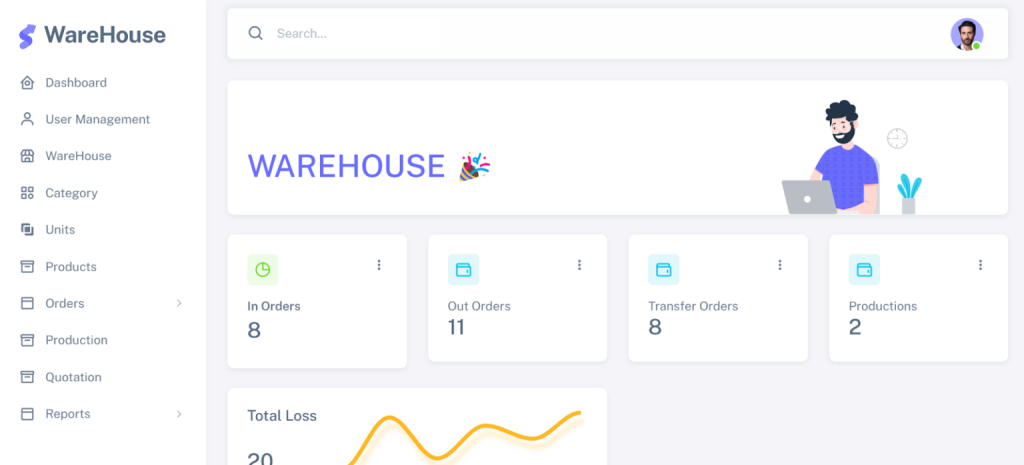
Warehouse Management
This case study examines the implementation of an advanced Warehouse Management System (WMS) designed to revolutionize inventory control, streamline order processing, and enhance overall operational efficiency across multiple warehouses. The system offers a comprehensive suite of tools accessible through an intuitive user interface, catering to various aspects of warehouse operations and production management.
The Warehouse Management System is a sophisticated web-based application developed to address the complex needs of modern warehouse and production operations. It provides a centralized platform for managing inventory, processing orders, overseeing production, and generating detailed reports, all accessible through a user-friendly dashboard and organized side panel navigation.
User Interface
Dashboard : The central hub for users upon login, displaying critical information and key performance indicators.
Side Panel Navigation : A comprehensive menu system providing access to all major modules and functionalities.
Core Modules:
1. Dashboard
2. User Management
3. Warehouse Management
4. Category Management
5. Units Management
6. Product Management
7. Order Processing
8. Production Management
9. Quotation System
10. Reporting System
The Warehouse Management System was developed as a responsive web application, ensuring accessibility from various devices and locations. Key aspects of the implementation include:
Modular Design: | Allowing for easy updates and additions to functionality. |
Real-time Data Processing: | Ensuring all users have access to the most current information. |
Integration Capabilities: | APIs for connecting with other business systems (e.g., ERP, CRM). |
Mobile Responsiveness: | Enabling warehouse staff to perform tasks on mobile devices. |
Customizable Workflows: | Adapting to specific business processes and requirements. |
Enhanced Inventory Accuracy: | Real-time tracking and multi-warehouse management have significantly reduced discrepancies and stockouts. |
Improved Order Fulfillment: | Streamlined processes have led to faster, more accurate order processing and reduced shipping errors. |
Optimized Production: | Integration of production data with inventory has improved resource allocation and reduced waste. |
Better Decision Making: | Comprehensive reporting tools provide actionable insights for strategic planning. |
Increased Operational Efficiency: | Automation of routine tasks has freed up staff for more value-added activities. |
Improved Supplier and Customer Relations: | Better management of quotations, orders, and deliveries has enhanced relationships with both suppliers and customers. |
Scalability: | The system’s flexible architecture supports business growth and adaptation |